

Your Inventory Feed Isn't the Problem. Your Campaign Speed Is.
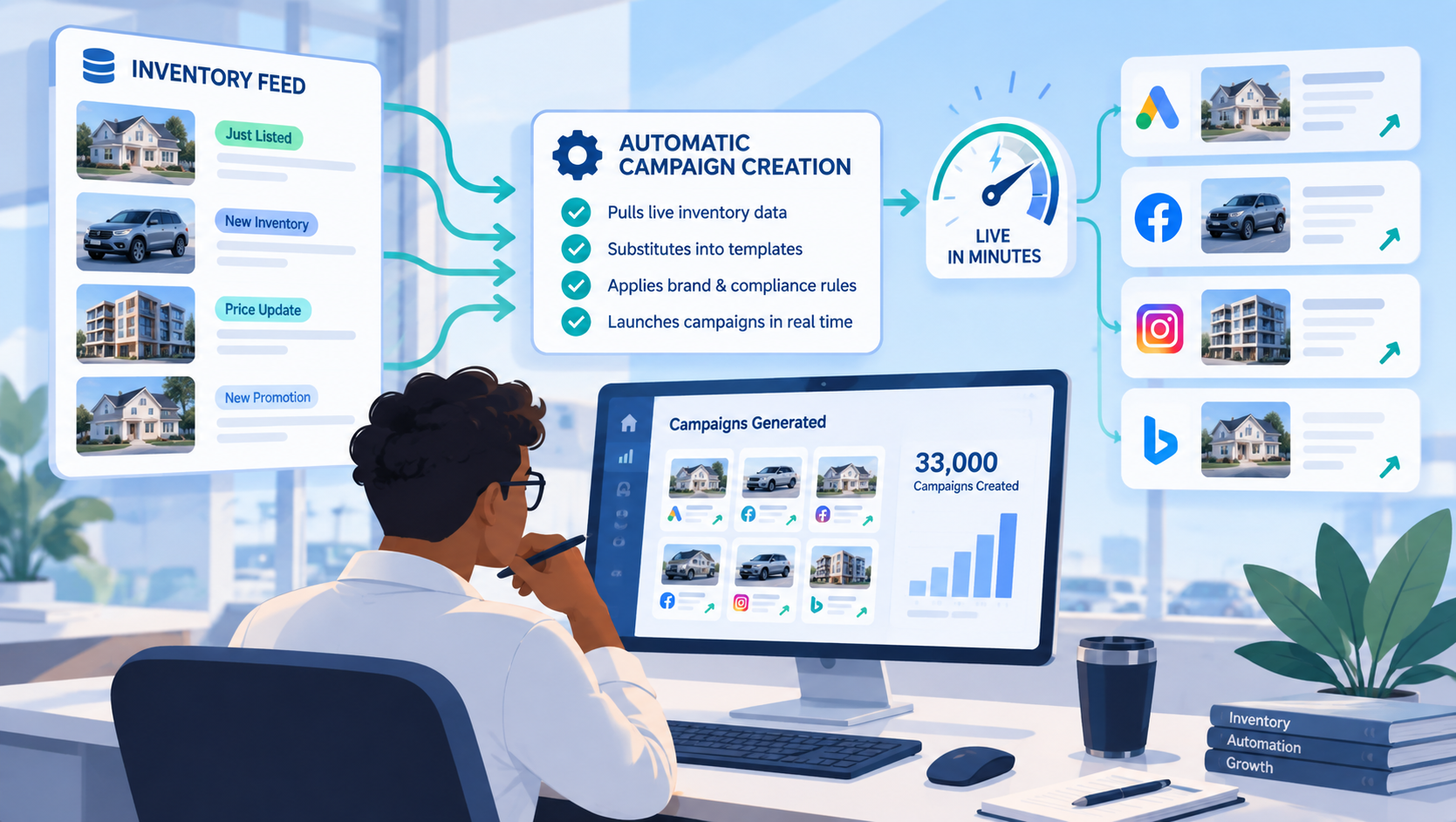
Most marketing teams aren't short on data anymore. A real estate platform has listing feeds updating constantly. A dealer group has inventory feeds tracking every vehicle on the lot. A franchisor has location and offer data sitting in a system somewhere, accurate and current. The data exists, it updates in real time, and it sits mostly unused for campaign purposes because turning it into a live campaign still requires a person to do the work.
The gap between having data and using it
A listing goes live, or a vehicle hits the lot, or a location rolls out a new promotion, and somewhere there's a campaign that should reflect that change immediately. In most operations, that update happens on a lag: sometimes a few hours, sometimes a few days, because someone has to manually rebuild or edit the relevant campaign to match what changed. By the time that happens, the moment the data was actually most useful has often already passed.
This is the quiet failure mode behind "we have great first-party data" as a talking point. The data being accurate and current doesn't matter much if the campaign built from it is stale by the time it finally launches. Fresh data feeding a slow process still produces a slow result.
What changes when substitution is automatic
The fix isn't more data, and it isn't a bigger analytics team. It's removing the lag between the data changing and the campaign reflecting that change. When a template is built once and inventory substitutes in automatically as it updates, a listing going live can mean a campaign going live in the same window, not the same week.
A real estate platform working this way built 33,000 listing campaigns in a single day, work that would have taken roughly 900 human hours to complete manually. That's not a modest efficiency gain worth a footnote. It's the difference between a campaign operation that can actually track a fast-moving inventory feed in real time and one that's always running a step or two behind it, reacting instead of keeping pace.
Governance doesn't disappear, it has to scale too
For multi-location and multi-agent operations, this raises an obvious and fair question: if campaigns are generating automatically from a feed, who's actually controlling what goes live? The answer has to be built into the system itself, not bolted on afterward as a review step. A major real estate brokerage runs campaigns for over 200,000 agents with corporate-level governance intact, meaning brand standards, budget limits, and compliance rules apply automatically at the moment of generation, not as a manual review that slows everything back down to the old pace.
That's the actual promise of first-party data done right. Not just knowing more about your inventory than you used to, but having operations fast enough to act on it the moment it changes, without losing control of what gets published in the process of moving that fast.
It's worth noticing how often "we need better data" gets proposed as the fix for a problem that's actually about operational speed, not data quality. A team can spend a quarter investing in better feeds, cleaner tagging, and more granular reporting, and still end up with the same multi-day lag between a real-world change and a campaign reflecting it, because the bottleneck was never the data in the first place. The feed was already good enough. What it needed was a faster path from feed to live campaign, which is a buildout problem, not a data problem, and the two require very different fixes, built by very different parts of a team, with very different timelines attached to them.
