

GEO Is Becoming a Paid Ad Surface. Here's What That Means for Campaign Operations.
A major publisher is quietly testing generative engine optimization (GEO) with brand partners before turning AI visibility into a paid product. Translation: showing up inside AI-generated answers is about to become something you buy, not just something you earn.
That's a new line item in your 2027 media plan. And if you run campaigns for dozens of dealers, hundreds of locations, or tens of thousands of listings, it's also a new operational problem you haven't scoped yet.
A new surface means a new buildout
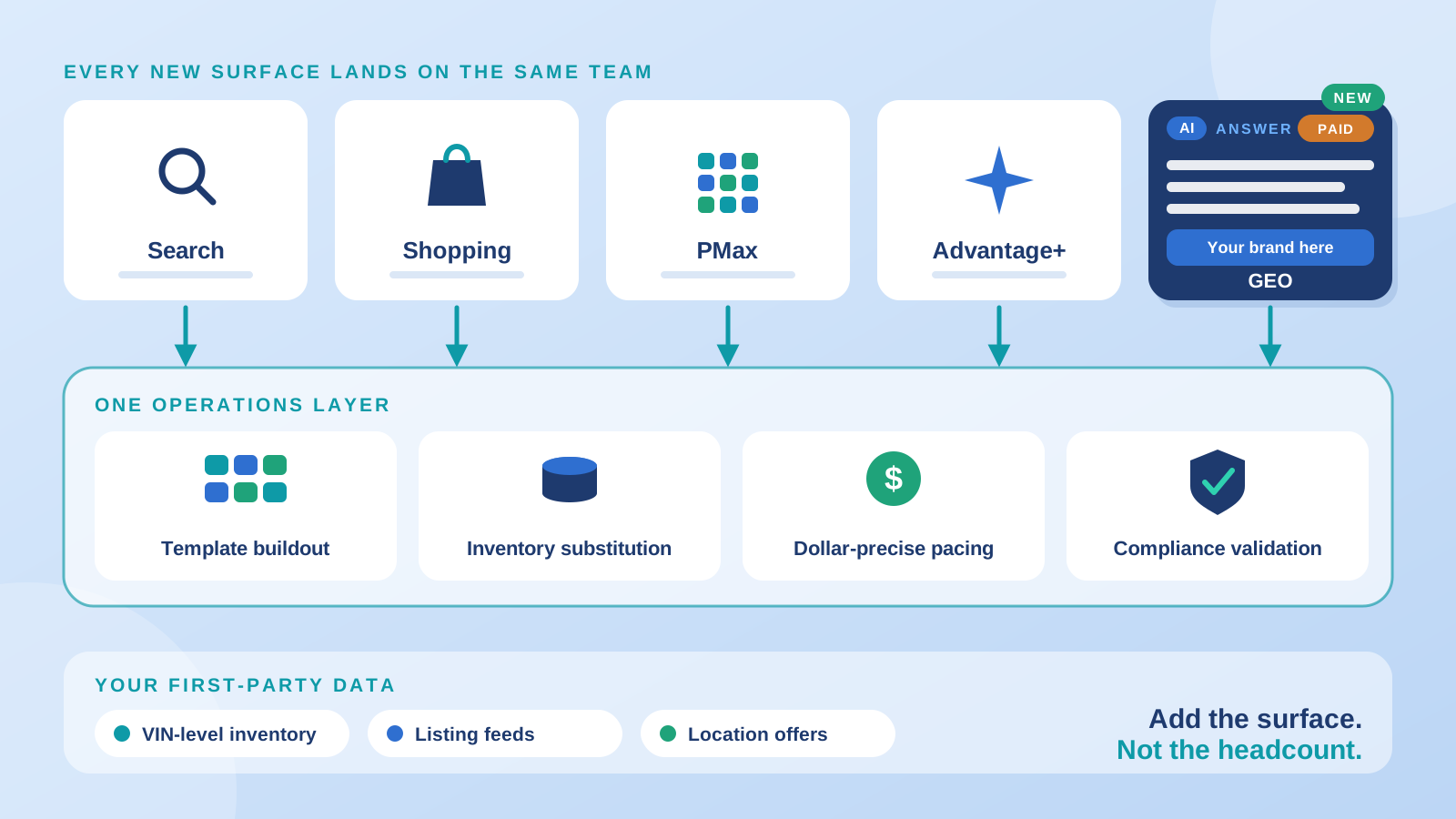
Every time a new ad surface gets productized, the same thing happens. Google Search, then Shopping, then Performance Max, then Meta Advantage+. Each one arrives with its own structure, its own creative requirements, and its own rules. And each one lands on the desk of the same campaign team that's already stretched thin.
GEO will be no different. When AI visibility becomes a paid placement, brands will need to feed it the same things every surface demands: structured product or inventory data, approved copy, and budget that has to be paced and reconciled. The difference is that GEO is inventory-driven by nature. AI answers are assembled from feeds, listings, and first-party data. That's exactly the kind of work that breaks when it's done by hand.
For an automotive group, that means VIN-level data flowing into a new channel on top of Search, PMax, and Meta. For a real estate platform, it means tens of thousands of listings that change daily. For a franchisor, it means another surface where franchisees can run whatever they want with zero corporate governance. The surface is new. The operational tax is the same one teams already pay.
First-party data is only as useful as your operations
Here's the part most teams will underestimate. GEO rewards brands that can act on their own data fast. The AI answer pulls from the freshest, most structured feed, not the one that was accurate three weeks ago.
That's a problem for anyone whose inventory changes constantly and whose campaign operations can't keep up. A real estate platform built 33,000 listing campaigns in a single day using feed-based automation. The same work done manually would have taken roughly 900 human hours. When GEO becomes a buyable surface, that gap between what your data could do and what your team can actually execute becomes the whole game.
The brands that win the AI visibility layer won't be the ones with the biggest budgets. They'll be the ones who can push accurate, compliant, inventory-aware campaigns into a new channel without adding a dozen people to do it. First-party data you can't act on quickly is just a spreadsheet.
Scale the surface, not the headcount
The honest read on this news isn't that GEO is coming. It's that the number of surfaces a campaign team has to manage keeps climbing, and the manual approach was already failing before AI visibility entered the picture.
If campaign creation is still 80% manual today, adding a new paid channel doesn't make that better. It makes it worse. Every new surface multiplies the buildout work, the pacing work, and the compliance checks. An agency that grows by hiring one person per new account or per new channel hits a ceiling fast. A national automotive marketplace automated its entire campaign operation and cut staff requirements by 75%, which is the only version of scale that survives a world with more surfaces, not fewer.
The automation layer that handles template-driven buildout, dynamic inventory substitution, dollar-precise pacing, and compliance validation across Search and Meta is the same layer that will eventually handle GEO. You don't rebuild your operations for every new channel. You add the channel to operations that already scale.
The takeaway for 2027 planning
GEO as a paid product is still early. But the signal is clear: the number of places you have to show up is growing, and the teams planning for it now are the ones thinking about operations, not just budget allocation.
The question isn't whether you'll buy AI visibility. It's whether your campaign operations can absorb another surface without breaking, or whether every new channel turns into another hiring decision.
If your answer to the next new ad surface is "hire more people," you've already lost the math. Which surface added to your workload this year without adding to your capacity?
