

Synthetic Audiences Are Only as Good as the Campaigns You Can Actually Build
Synthetic audiences are having a moment. Agencies and clients are building AI-generated audience models to test creative, simulate media plans, and pressure-test strategy before a dollar of spend goes out the door. The planning side is getting smarter fast.
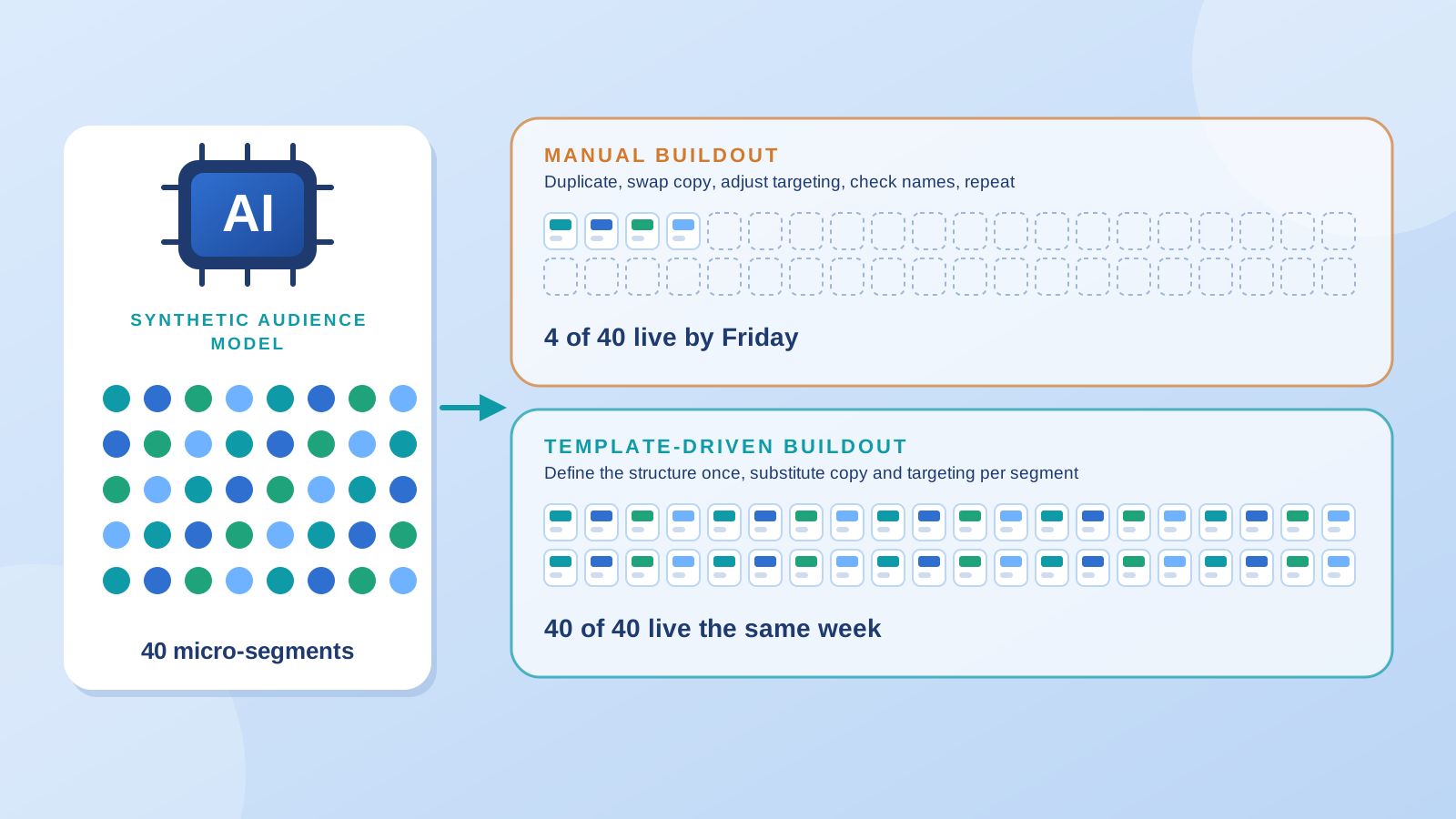
But here's the problem nobody in those briefings is talking about: a synthetic audience that identifies 40 micro-segments is worthless if your team can only build campaigns for four of them by Friday.
The bottleneck was never insight. It was buildout.
The gap between the plan and the live campaign
Most agency planning teams can already generate more targeting hypotheses than their account teams can execute. Synthetic audience modeling makes that gap wider, not narrower. You now have an AI telling you to run 30 variations across audiences, geos, and creative angles. Great. Who's building the 30 campaigns?
That's where the manual ops tax shows up. Campaign creation at most agencies is still 80% manual. Someone opens the editor, duplicates a structure, swaps copy, adjusts targeting, checks naming conventions, repeats. A single buildout that should reflect a sharp synthetic insight instead takes over an hour. Multiply that across every segment the model surfaced and the strategy quietly dies in the backlog.
Synthetic data is pushing media planning into the future while buildout stays stuck in 2015. You can't act on first-party or modeled data any faster than your operations allow.
What execution at the speed of the model looks like
The agencies that will win with synthetic audiences aren't the ones with the best models. They're the ones who can turn a model's output into live campaigns the same day.
That means template-driven buildout, not manual duplication. You define the campaign structure once, then spin up variations across every audience segment the model recommends, with dynamic substitution handling the copy, creative, and targeting differences. A campaign that used to take over an hour now takes under 15 minutes. That's the difference between testing 4 synthetic segments and testing all 40.
It also means launching at volume without the headcount math breaking. A real estate platform built 33,000 listing campaigns in a single day. That same work would have taken 900 human hours by hand. The point isn't the raw number. It's that when your execution layer scales like that, a synthetic audience model becomes an asset you can fully exploit instead of a report that makes your backlog longer.
And it means pacing and management keep up too. More audience variations means more campaigns to monitor, more budgets to pace to the dollar, more bulk actions when a segment underperforms. The planning intelligence is only valuable if the management layer underneath it can absorb the complexity.
Insight without execution is just a nicer-looking backlog
Synthetic audiences are a real step forward for media planning. But the briefings celebrating adoption are measuring the wrong thing. The question isn't how good your audience model is. It's how many of its recommendations you can actually put into market before the insight goes stale.
An agency that models 40 segments and ships 4 has not become more data-driven. It has just created a more detailed record of the work it didn't have the capacity to do.
The teams pulling ahead are closing the gap between the plan and the live campaign. They treat buildout, pacing, and management as an automation problem, not a staffing problem, so that every segment the model surfaces can be tested, measured, and scaled. That's what lets synthetic data pay off instead of pile up.
The smarter your planning gets, the more your execution layer matters. If your campaign operations can't move at the speed of your audience modeling, the modeling is just making your bottleneck more expensive.
So here's the question worth asking before you invest another dollar in synthetic audience tooling: if the model handed your team 40 segments tomorrow, how many could you actually have live by the end of the week? If the honest answer is a handful, the model isn't your constraint. Your buildout is.
