

Why New Ad Channels Stay Stuck at Test Budgets (And What Actually Unlocks Scale)
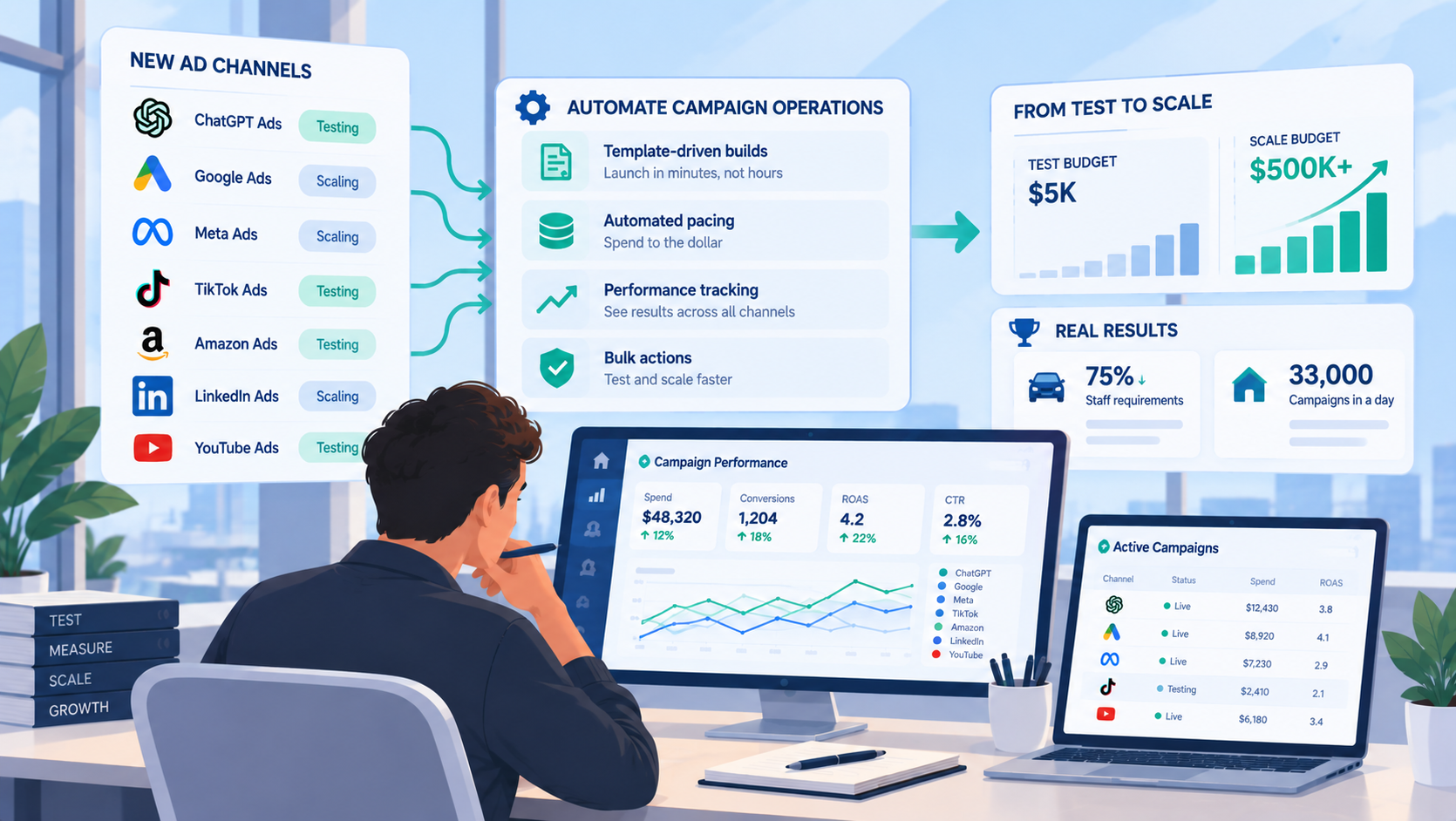
Advertisers are holding ChatGPT ad budgets at test level, and the reason has nothing to do with the creative or the audience. It's measurement. According to recent reporting, buyers can't get clean attribution or reliable performance data out of the new channel, so the spend stays frozen in experiment mode.
That's the real story of every new ad surface. The channel isn't the bottleneck. The operational layer underneath it is.
If you run campaigns at scale, you already know this pattern. A new platform opens up, everyone wants in, and then the budgets stall because nobody can prove what's working fast enough to justify moving real money. The excitement is free. The accountability is expensive.
The gap isn't the channel, it's the operations around it
When a channel is new, the API is thin, the reporting is incomplete, and the manual work to build, track, and reconcile campaigns is brutal. Teams end up stitching together spreadsheets, screenshots, and best guesses. That's fine for a $5,000 test. It falls apart at $500,000.
This is the same wall agencies hit on channels that are a decade old. Campaign creation is still 80% manual at most shops. If you can't build fast, you can't test fast. And if you can't measure cleanly, you can't scale what the tests prove. The channel gets blamed, but the real limit is the buildout and reporting process behind it.
The agencies and multi-location brands that move budget aggressively into new surfaces aren't braver. They have an operational layer that lets them launch, track, and reconcile at volume. When measurement is handled, a test budget becomes a scale budget in weeks instead of quarters.
What "ready to scale" actually requires
Three things have to be true before a channel graduates from test to real money.
First, buildout has to be fast and repeatable. A campaign that takes over an hour to build by hand can't support hundreds of variations. With template-driven creation, a campaign that used to take an hour builds in under 15 minutes. That's the difference between running three tests a month and thirty.
Second, budgets have to pace correctly to the dollar. Nothing kills confidence in a new channel faster than overspend or underspend that nobody caught until the invoice arrived. Automated pacing removes that risk, which is exactly the risk that keeps CFOs capping new-channel spend.
Third, performance has to be visible across every campaign at once. Bulk actions and performance alerts mean you spot what's working and shift budget without logging into twelve dashboards. That's how a test signal turns into a scaling decision instead of a stalled one.
We built Chassis for the teams running the most complex ad operations, where this exact problem shows up every time a new surface opens. A national automotive marketplace automated its entire campaign operation and cut staff requirements by 75%. A real estate platform built 33,000 listing campaigns in a single day, work that would have taken 900 human hours by hand. That operational capacity is what makes new channels adoptable at scale, not just testable.
The channels that win are the ones you can operate
Here's the uncomfortable part. OpenAI will close its measurement gaps eventually. Every channel does. But by the time it does, the advertisers who already had the operational muscle to build fast, pace precisely, and measure across their whole account will be miles ahead of the ones still waiting for a cleaner dashboard.
The lesson isn't about ChatGPT ads specifically. It's that the next channel, and the one after that, will stall at the same point for the same reason. The teams that win early aren't the ones who bet on the right surface. They're the ones who can plug any surface into an operations layer that handles buildout, pacing, and measurement without adding headcount.
New channels don't stay at test budgets because they're unproven. They stay there because the operations around them aren't ready. Fix that, and every new surface becomes a scale opportunity instead of a stalled experiment.
When the next channel opens up, will your team be ready to scale into it in weeks, or stuck running tests until someone else builds the measurement layer for you?
