

When AI Eats Organic Discovery, Paid Campaign Infrastructure Becomes the Durable Channel
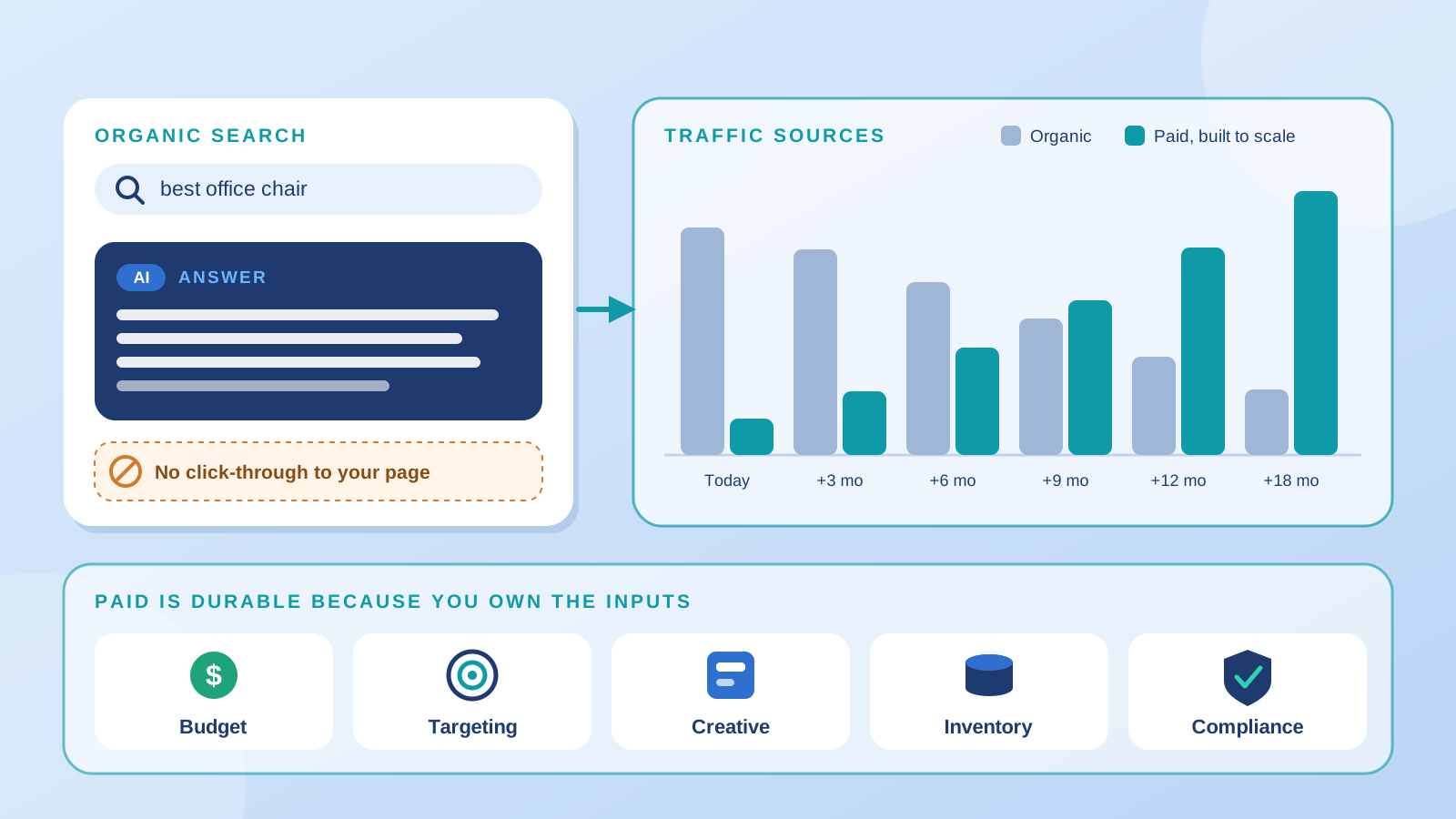
Wirecutter built a business on ranking first when someone searched "best office chair." That business is now being rebuilt, because AI-generated answers are intercepting the click before it ever reaches a results page.
The specifics are a publisher story. The lesson is not. Any brand or agency that leaned on organic search as its primary acquisition channel is now watching the ground shift under the same assumption: that a page ranking well today will keep sending traffic tomorrow.
For multi-location brands and the agencies that serve them, this isn't abstract. It's a direct threat to the channel many have quietly depended on for years.
Organic was never free. It was just cheap until it wasn't.
The appeal of organic search was simple. You invested once in content and rankings, and traffic compounded without a media budget line. For a dealer group with 40 rooftops or a brokerage with thousands of listings, that was a convenient way to avoid the operational cost of running paid campaigns at scale.
But organic was always a rented channel, not an owned one. When the algorithm changed, your traffic changed. Now AI-driven answers are changing the algorithm more fundamentally than any ranking update ever did. The query that used to send a shopper to your listing page increasingly ends inside a chat response that never links out.
The brands most exposed are the ones with the least control over the channel they rely on most.
Paid campaigns are durable because you own the inputs
Here's the uncomfortable trade: paid channels cost money, but you control them. You decide the budget, the targeting, the creative, and the inventory you promote. When discovery behavior shifts, you adjust pacing and reallocate spend the same week. You don't wait for an algorithm to decide whether you still exist.
The problem has never been whether paid works. It's that running paid campaigns at the scale multi-location brands need has been operationally brutal. A real estate platform with constantly changing listings, an automotive group managing VIN-level inventory across OEM compliance rules, a franchisor with no real visibility into what each location runs: these teams have historically leaned on organic precisely because standing up thousands of paid campaigns by hand wasn't realistic.
That's the actual barrier. Not strategy, operations.
The infrastructure question most brands skipped
If paid becomes the channel you can't afford to deprioritize, the next question is whether your operation can run it at scale without tripling your team.
This is where campaign infrastructure stops being a nice-to-have. A real estate platform built 33,000 listing campaigns in a single day using template-driven automation and dynamic inventory substitution. The same work would have taken roughly 900 human hours by hand. A national automotive marketplace automated its entire campaign operation and cut staff requirements by 75%.
Those numbers matter because they describe the difference between a channel you can scale into and one you can only afford to run partially. When organic was carrying the load, a half-built paid operation was tolerable. As organic erodes, the gaps in your paid infrastructure become the gaps in your revenue.
The brands that treated paid as a manual, campaign-by-campaign effort are the ones who will feel this shift hardest. Dynamic inventory feeds, automated budget pacing, bulk actions, and compliance validation aren't optimizations anymore. They're what makes paid viable as a primary channel instead of a side bet.
The takeaway for brands over-indexed on search
Wirecutter's response to AI reshaping discovery is to diversify its revenue model before the old one fully erodes. The smart move for search-dependent brands is the same: build the paid infrastructure now, while organic still contributes, rather than scrambling to stand it up after the traffic is already gone.
The companies that survive channel shifts aren't the ones who predicted them. They're the ones who built an operation flexible enough to redirect spend quickly when the shift arrived.
If AI cut your organic discovery traffic in half over the next 18 months, how fast could your team actually scale paid to replace it? If the honest answer is measured in quarters and new hires, that's the gap worth closing first.
