

What Campaign Health Scores Are Actually For
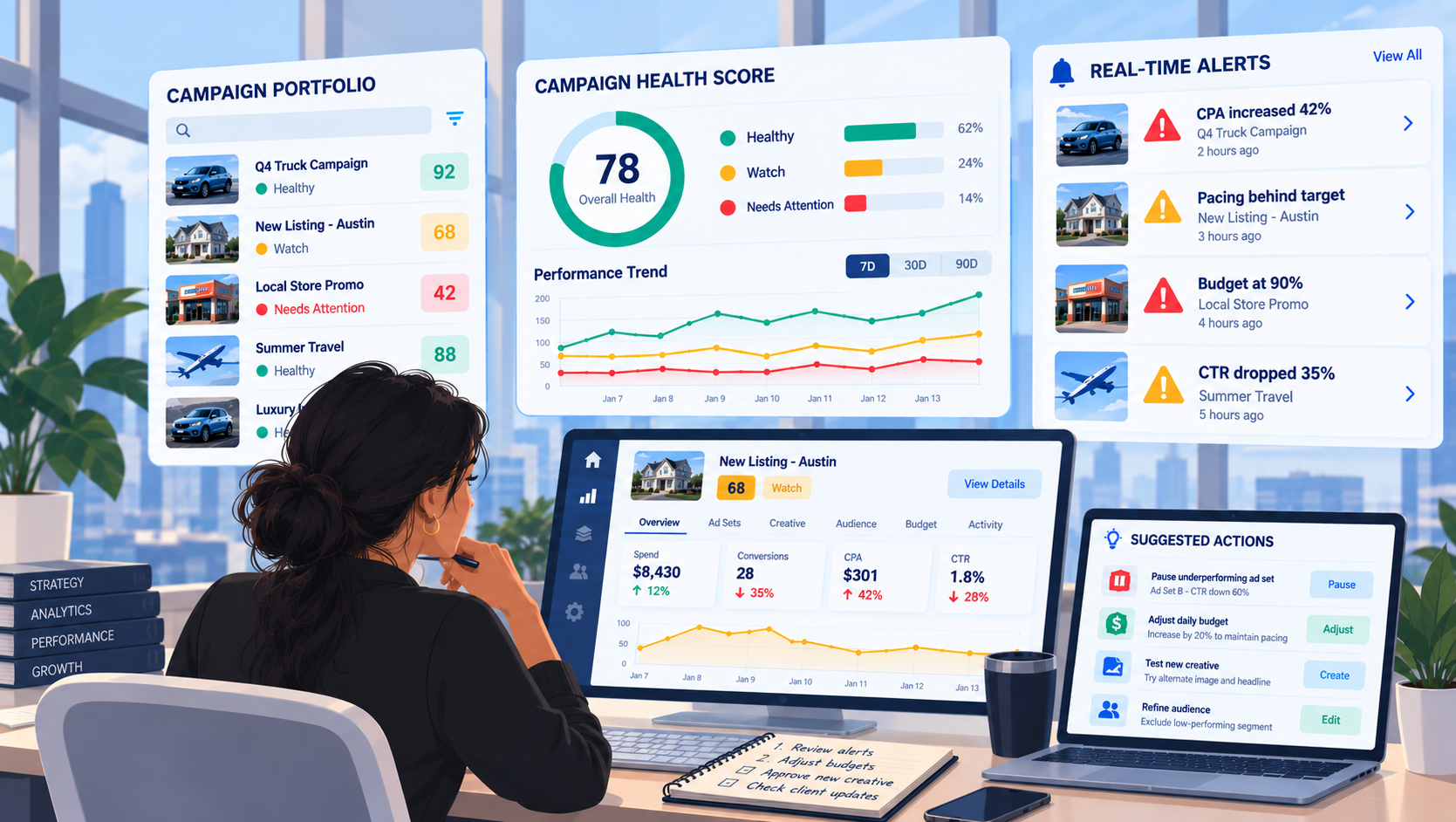
Most campaign problems get caught the same way, over and over again: someone opens a weekly report and notices a campaign has been quietly underperforming for days. By the time that happens, the budget already spent on it is gone for good, and whatever fix follows, if there is one, comes after the damage is done rather than before it. That lag between a campaign going wrong and someone actually noticing is one of the more expensive quiet costs in paid media, and it rarely gets talked about directly.
Why weekly reporting isn't fast enough anymore
A weekly reporting cadence made sense back when checking every single campaign daily simply wasn't realistic for one person managing dozens of accounts by hand. It doesn't make nearly as much sense anymore, not because reporting itself got any harder to produce, but because campaign volume for teams running templated, automated builds has grown well past what a human being can reasonably monitor on any kind of fixed weekly schedule.
The problem isn't that account managers aren't paying attention or aren't good at their jobs. It's that there's more happening across more campaigns than any one person can watch closely, every single day, across every account they're responsible for.
What a health score actually changes
A campaign health score isn't meant to replace human judgment, and it shouldn't try to. It's a way of surfacing the specific campaigns that need that judgment right now, instead of requiring someone to go looking for them across a sea of campaigns that are mostly fine. A pacing issue, an underperforming ad set, a budget that's about to blow through its cap, all of these can be flagged the moment the pattern first appears, rather than whenever someone next happens to open that particular account's dashboard.
This changes what "monitoring" actually means in practice for an account team. Instead of scanning every single campaign on a fixed schedule, hoping to catch problems before they get too expensive, the team is instead reviewing a much shorter, more targeted list: the specific campaigns the system has already flagged as genuinely needing attention. The rest keep running quietly in the background, unremarkably, exactly as they should, without anyone needing to check in on them constantly.
Where this is actually headed
Health scores are an early version of a much bigger shift already underway: campaign management moving from a set of dashboards a person has to remember to check, toward a system that checks itself continuously and tells a person when something genuinely needs their attention. That doesn't remove the person from the loop at all, it changes their job from constant, low-value monitoring to targeted, high-value decision-making, which is a dramatically better use of an experienced account manager's time by almost any measure you want to apply.
The teams adopting this early aren't necessarily the ones running the most campaigns overall. They're the ones who stopped finding out about problems a week after those problems actually started.
There's a simple way to tell which category an operation currently falls into. Ask an account manager how they found out about the last campaign issue they fixed. If the honest answer involves a scheduled report, a client noticing first, or a Monday morning scramble, the monitoring is still reactive, no matter how good the dashboards look. If the answer is that the system flagged it before it became a real problem, that's the shift already working as intended, and it's worth noticing how different that conversation feels once it happens, compared to the version where a client brings up the problem first.
