

The Real Cost of Building Your Own Google and Meta Ad Integrations
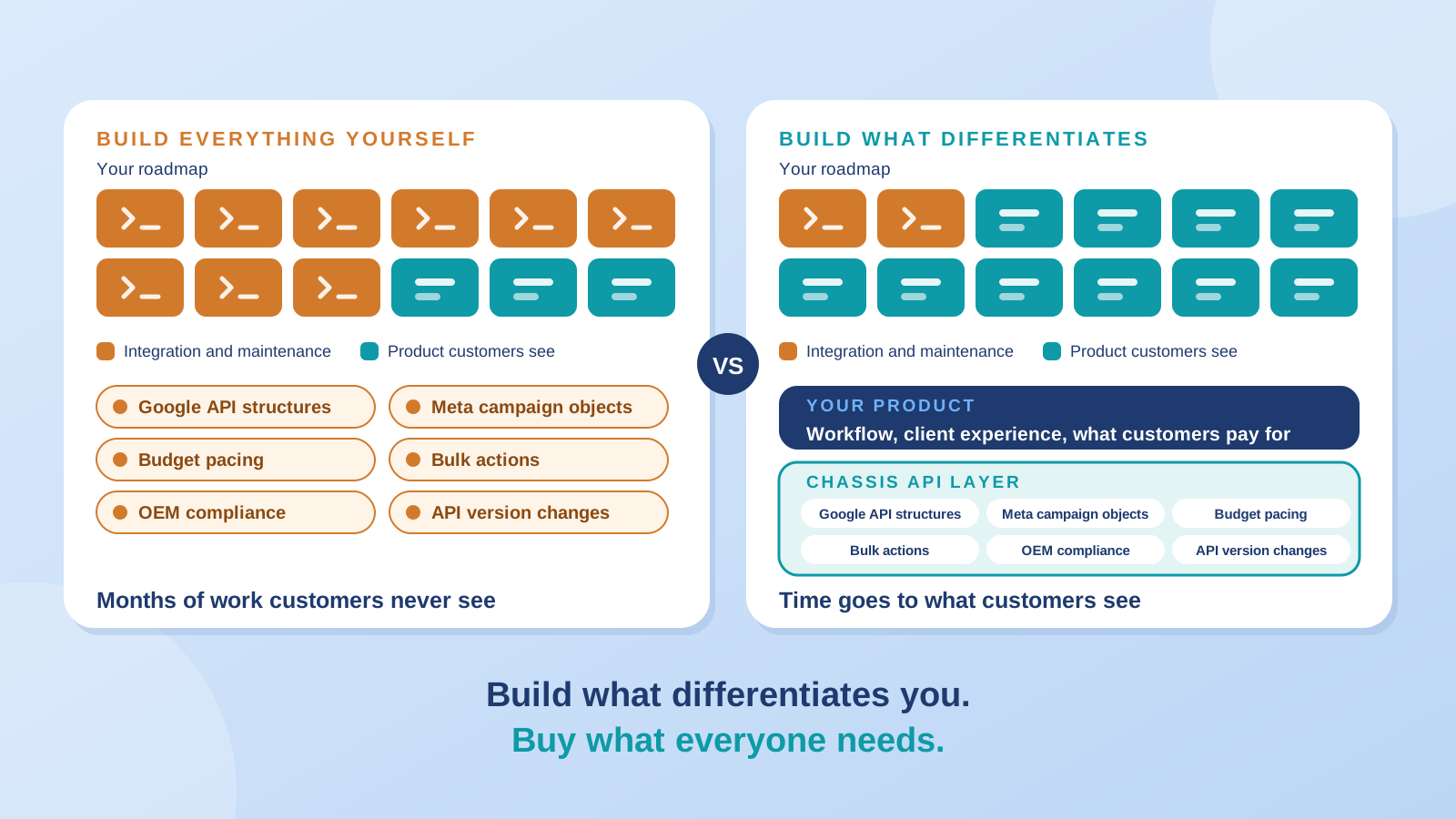
Twelve months is how much integration work one agency skipped when it built its own platform on Chassis APIs. Not because Google and Meta are easy to connect to. Because someone had already done the work.
That's the part of the build-versus-buy math most platform teams skip. The first estimate for an ad API integration is almost always a few sprints. The real number shows up later, in the maintenance.
The integration is never the whole project
A first working connection to Google or Meta feels like progress. You can create a campaign, pull a report, and demo it to the team. Then the actual requirements arrive.
Search and Performance Max have different structures than Meta campaigns. Each has its own creative requirements, its own limits, and its own error behavior. Budgets have to pace correctly to the dollar, which means reliable spend data and logic that acts on it. Bulk actions have to be safe at volume, because one bad batch edit across hundreds of campaigns is a bad week. Performance alerts have to fire before the invoice does.
None of that is your product. Your product is the workflow, the client experience, the thing your customers actually pay for. Every hour spent on API plumbing is an hour not spent on it.
Platforms change, and your integration has to change with them
Ad platforms update their APIs, deprecate fields, and adjust rules on their own schedule. An integration you built is an integration you now own, indefinitely. That means a standing slice of engineering time reserved for keeping connections working, testing against changes, and fixing what breaks when a version sunsets.
For a small platform team, that slice is a real cost. It's the engineer who could have shipped the feature your biggest prospect asked for. It's the quarter where your roadmap quietly stalled because two people were chasing a breaking change.
Compliance adds another layer for some verticals. Automotive campaigns, for example, have to respect OEM rules that vary by manufacturer. Building that validation yourself means encoding the rules, keeping them current, and catching violations before a campaign goes live. That's a product in its own right, and it isn't the one you set out to build.
What to build and what to buy
The useful question isn't whether your team can build the integration. Most can. The question is whether building it is the best use of the people who could be building something your customers can see.
A practical way to sort it: build what differentiates you, buy what everyone needs. Template-driven campaign creation, dynamic inventory substitution, budget pacing, bulk management, and compliance validation are table stakes for any serious ad product. Your customers expect them to work. They won't choose you because you wrote them yourself.
That's why Chassis has an API layer. Teams building their own platforms can use it to skip the integration groundwork and spend their time on the product on top. Google and Meta both refer enterprise clients to Chassis when those clients need custom integrations, which says something about where the line between standard and custom tends to fall. And when a campaign that once took over an hour to build can be created in under 15 minutes, that saving carries through to every customer your platform serves.
Run the numbers before you commit
Before you start, put real figures on both sides. Estimate the initial build, then add the ongoing maintenance honestly, including the engineers who'll be pulled off roadmap work every time a platform changes something. Compare that against the cost of starting from an existing layer.
If the build side only looks good because the maintenance line is empty, it isn't a real estimate yet.
The teams that ship fastest aren't the ones who write everything themselves. They're the ones who decide early which problems are theirs to solve, and stop spending time on the rest.
So here's the question for your next planning meeting: how many months of your roadmap are currently reserved for work your customers will never see?
