

What Meta's Data Center Buildout Means for the Teams Running Ads on It
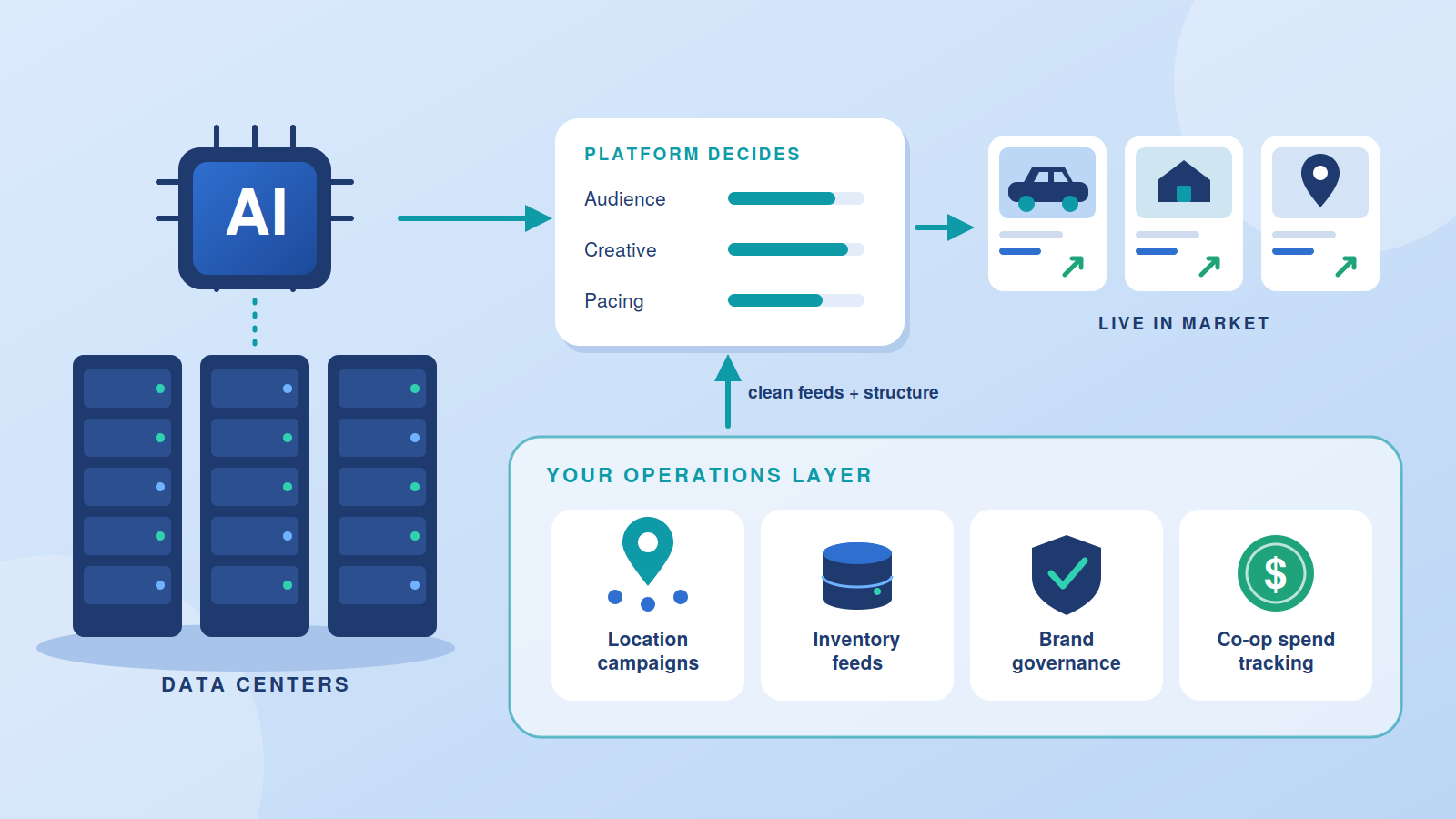
Meta is spending tens of billions on data centers to power its AI. For most ad teams, that reads like infrastructure news that has nothing to do with the daily grind of campaign buildout. It isn't.
Every dollar Meta pours into compute shows up eventually in the ad products you work with: better delivery models, more automated bidding, Advantage+ creative that leans harder on the platform's own AI. The direction is clear. Meta wants to make more of the campaign decisions itself. The question for anyone running ads at scale is simple: what's left for your team to do, and are you set up to do it well?
The platform is automating the decisions, not the operations
Here's the distinction most teams miss. Meta's AI investment is aimed at optimization decisions, which audience, which creative variant, how to pace spend inside a campaign. It is not aimed at your operations: standing up 200 location-level campaigns, swapping inventory feeds, enforcing brand governance across franchisees, or keeping co-op spend tracked and reconciled.
That operational layer is still yours. And for multi-location brands and agencies, it is still mostly manual. A franchisor with hundreds of locations doesn't have a Meta-AI problem. It has a buildout problem, a governance problem, and a visibility problem. No amount of platform-side compute solves those, because Meta doesn't know your org chart, your co-op rules, or which locations are allowed to run which offers.
So the more Meta automates the decision layer, the more the operational layer becomes the thing that actually separates teams that scale from teams that stall.
Feeding better AI requires better operations
Meta's models are only as good as what you feed them. Creative volume, clean inventory data, correctly structured campaigns, accurate budget signals. Teams that can't produce those at scale don't get the full benefit of the compute Meta is building, no matter how advanced it gets.
This is where feed-based automation stops being a nice-to-have. A real estate platform built 33,000 listing campaigns in a single day using Chassis, work that would have taken roughly 900 human hours by hand. That's not just a speed story. It means their listing inventory is actually represented in-market, accurately, the moment it changes. The platform's AI has something real to optimize against.
The same logic applies to a national automotive marketplace that automated its entire campaign operation and cut staff requirements by 75 percent. The point wasn't to remove people for its own sake. It was to put VIN-level inventory in front of Meta's delivery systems fast enough and accurately enough that the automation on Meta's side had good material to work with.
First-party data is only as valuable as your ability to act on it. You can have the cleanest inventory feed in your category and still lose if it takes your team a week to turn it into live campaigns.
What this means for how you plan
If you're an agency, the takeaway is uncomfortable but useful: competing on manual campaign execution is a shrinking game. Meta is automating the part a junior media buyer used to add value to. The durable value moves to operations, governance, and the ability to run more complex account structures than a competitor can staff for.
If you're a multi-location brand, the takeaway is about control. More platform automation without an operational layer on top means less visibility into what's actually running under your name across hundreds of locations. Corporate-level governance isn't something Meta provides. A major real estate brokerage runs Facebook Ads for more than 200,000 agents with exactly that governance in place, because the operational layer enforces it, not the platform.
Meta's data center story is really a story about where the work is going. The decision-making is moving to the platform. The operational discipline, the buildout speed, the feed accuracy, the governance, stays with you. Teams that invest there will get more out of every dollar Meta spends on compute. Teams that don't will watch the platform make smarter decisions on top of messy, slow, manual operations.
The infrastructure is being built for you. The question is whether your operations are ready to use it.
