

What Breaks First When Agencies Try to Scale
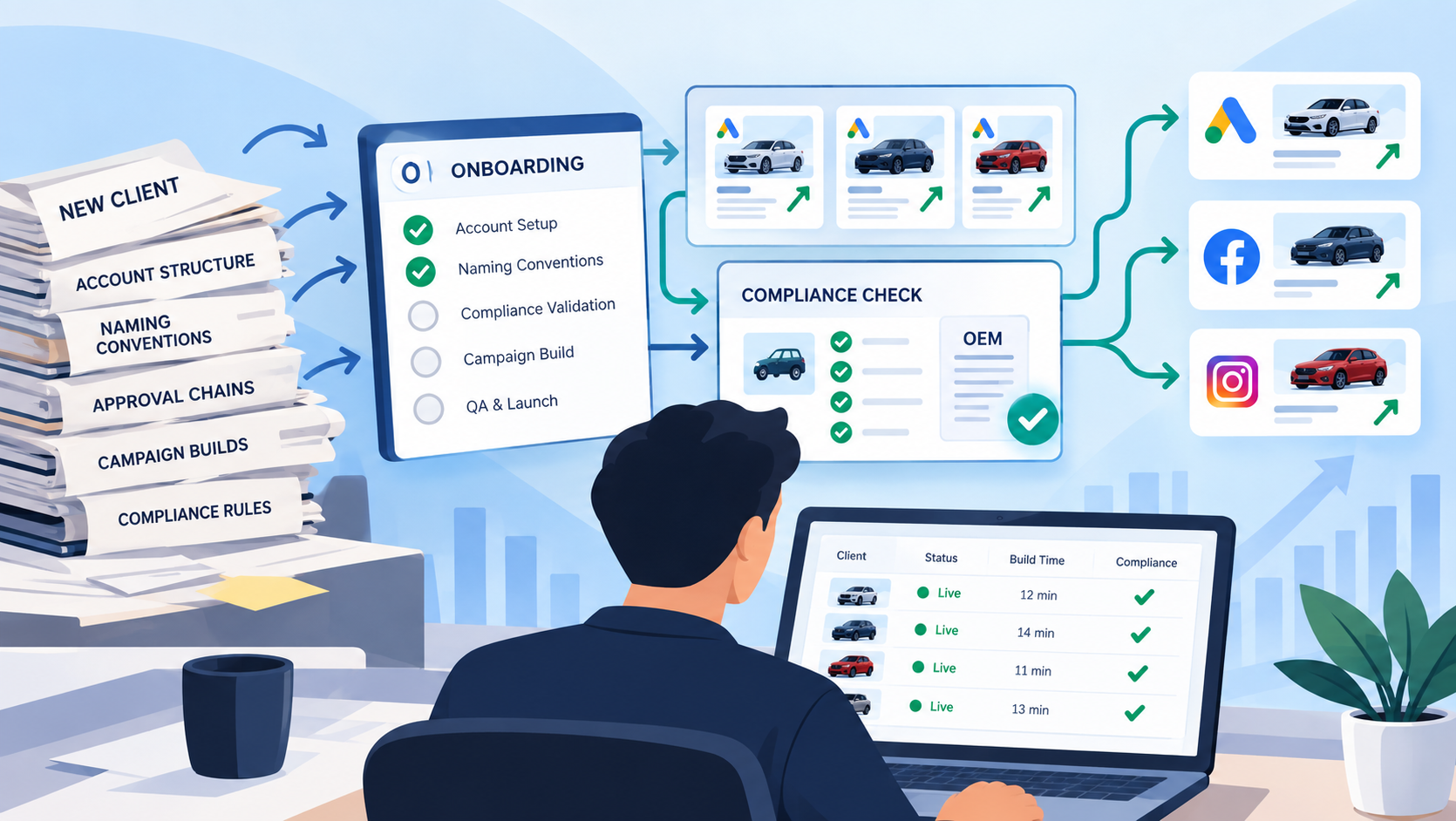
Every agency wants more clients. Almost none of them want to think about what happens to operations once those clients actually arrive. Scale doesn't fail all at once, in some dramatic, visible way. It fails in one specific place first, quietly, and that place is almost always campaign onboarding.
The onboarding bottleneck
A new client means new naming conventions, new account structures, new approval chains, and a full set of campaigns to build from scratch before anything can go live. If your process for onboarding client number five is the same manual process you used for client number one, client number twenty is where things start to slip. Builds get rushed because the team is stretched across too many onboardings at once. QA gets skipped because there isn't time to triple-check everything the way the process used to require. Someone launches a campaign with the wrong budget cap because nobody had the bandwidth to double-check it before it went live.
This is the part of growth nobody plans for in a sales forecast, because it doesn't show up as a line item anywhere. It shows up three months later, in client churn that gets blamed on "fit" or "budget" when the real cause was an onboarding process that couldn't hold up under volume it was never designed to handle.
Compliance makes it worse, not better
For agencies working in automotive, the problem compounds fast. OEM compliance rules vary by manufacturer, change without much warning, and carry real consequences when missed. VIN-level dynamic campaigns are close to unmanageable by hand once inventory turns over daily across dozens of dealer accounts. An agency running automotive accounts manually isn't just slow; it's one missed compliance rule away from a client relationship problem that has nothing to do with campaign performance and everything to do with process.
The agencies that scale past this point have built, or bought, a layer that handles compliance validation automatically as part of the build itself, not as a manual check somebody runs afterward and sometimes forgets. An automotive-focused agency that made this shift cut campaign build time by more than half, and did it while adding compliance checks into every build, not removing them to save time.
What "scale without breaking" actually looks like
It doesn't look like heroics, and it doesn't look like a team working late to hit a deadline. It looks boring, almost unremarkable: the tenth client onboards the same way the first one did, the hundredth campaign launches with the same QA rigor as the first one ever built, and nobody on the account team can remember the last time they stayed late to fix a launch mistake that should have been caught earlier.
That's the real test of whether an agency is actually built to scale. Not how fast it can add logos to a client list, but whether operations look the same at client fifty as they did at client five. Get that right, and growth stops being something operations has to survive and starts being something the system was already built to absorb.
The agencies that figure this out early tend to do one specific thing before they ever sign client number ten: they build the onboarding template once, with compliance and naming conventions baked in, rather than rebuilding it from memory every time a new client arrives. It feels like extra work in the moment, when there's only a handful of clients to manage, and everyone still remembers every detail by heart. It stops feeling optional the moment growth actually accelerates past what any one person can track in their head.
