

From Automation to Co-Pilot: What Changes Next
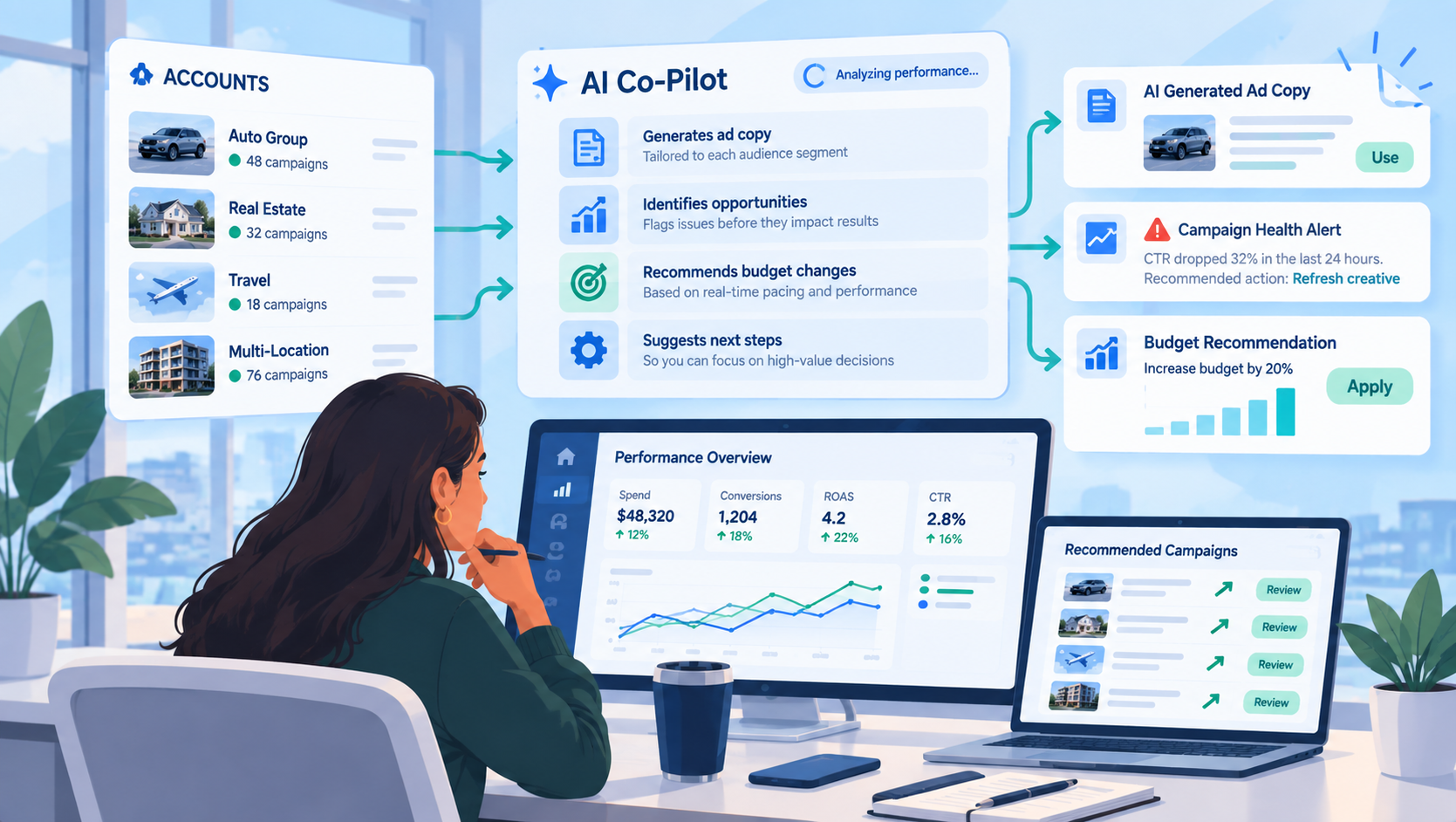
Campaign automation, as most teams currently use it, solves a specific and well-defined problem: building and launching campaigns faster than a person could by hand. That's already a meaningful shift for teams that were spending most of their week on builds instead of strategy. But it's still automation in the older sense of the word, a system executing rules a person defined in advance, nothing more.
What a co-pilot actually means
The next layer isn't about building campaigns faster than they already are. It's about a system that participates in deciding what to build in the first place. AI-generated ad copy that's actually tuned to a specific audience segment instead of generic filler copy nobody would click. Campaign health scores that flag a problem before it ever shows up in a weekly performance report. Budget recommendations based on pacing patterns a person would need hours of dashboard time to notice on their own, buried across dozens of active campaigns.
None of this replaces the person making the final call. What it changes is where that person's attention goes, moving it away from constantly scanning for problems and toward actually deciding what to do once a problem, or an opportunity, has already been surfaced for them.
Why this matters more as accounts scale
A single account manager can eyeball performance on five campaigns without much trouble, checking in once or twice a day and catching most issues before they get expensive. At fifty campaigns across a dozen clients, that kind of manual monitoring stops being realistic, not because the person isn't capable or isn't paying attention, but because there simply aren't enough hours in a working day to catch every pacing issue or underperforming ad set by hand across that much volume. This is exactly where a system that's actually watching continuously, and can surface or act on what it sees, stops being a convenience and starts being close to a requirement.
Where the line stays firm
There's a version of this that goes too far, where a system reallocates budget or changes a campaign's direction with no human in the loop and no real way to catch it if the underlying logic is wrong for that specific client. That's not the goal, and it shouldn't be. The goal is a system that handles the noticing and the routine, low-stakes adjustments on its own, and escalates the genuine judgment calls to a person, so the human overseeing an account is making fewer decisions per day, but better ones, backed by information they wouldn't have caught in time otherwise.
That's the actual shift from automation to co-pilot. Not less human involvement in running campaigns overall, but human involvement concentrated in exactly the specific places where it actually matters the most.
It's a useful distinction to keep in mind when evaluating any tool that claims to be "AI-powered" in this space. The question worth asking isn't whether a system uses AI somewhere in its process, most things will claim that soon enough. The question is whether it's actually reducing the number of decisions a person has to make in a day, or just adding another dashboard to check alongside all the others. One of those is progress. The other is just more noise wearing a newer label, and account teams tend to figure out which one they're dealing with faster than any vendor pitch deck would like, usually within the first month of actually using the thing day to day on real client accounts, well before any renewal conversation ever actually comes up on the calendar for that particular account team.
