

Why Headcount Isn't the Answer to Campaign Growth
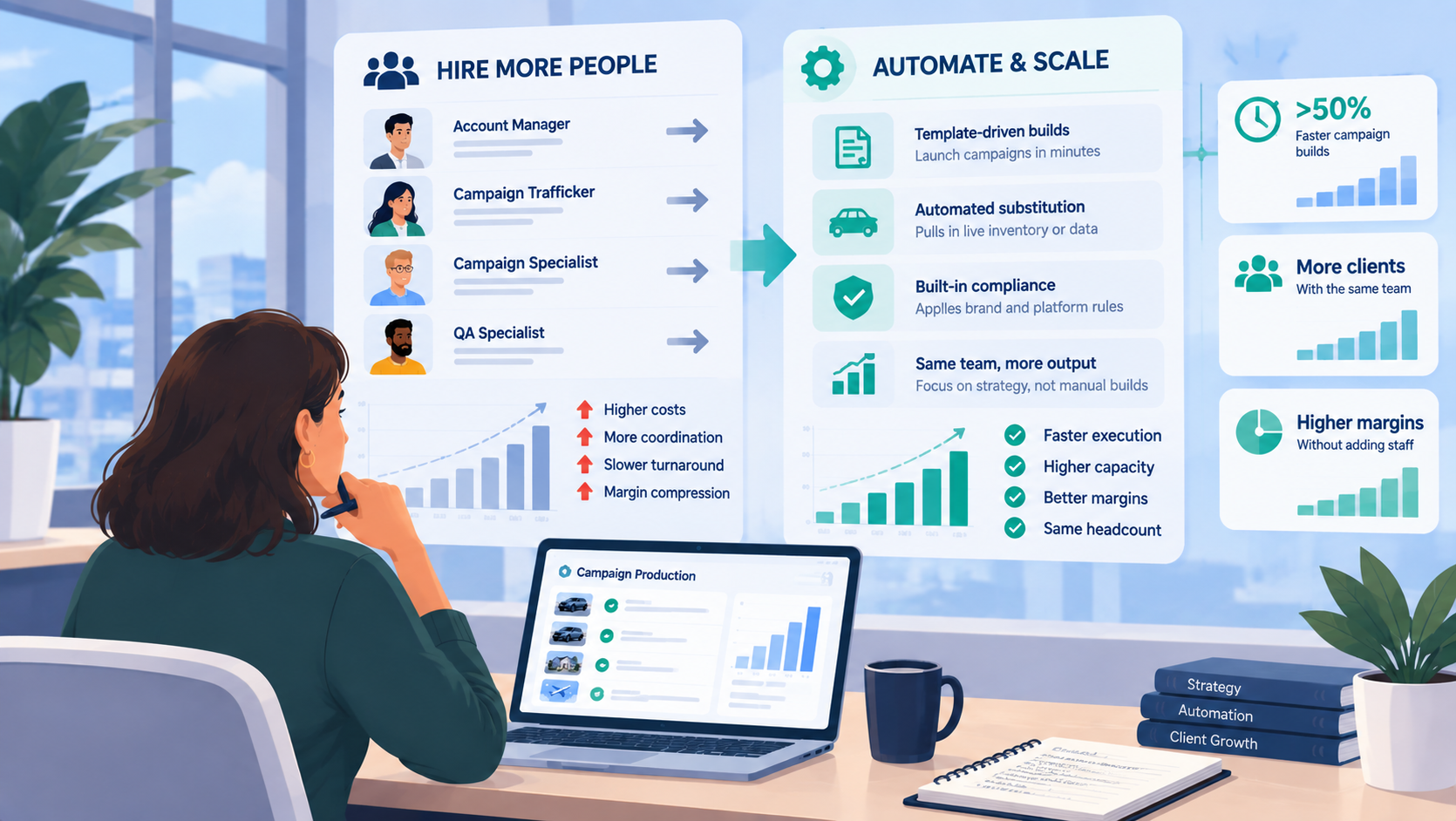
There's a default plan most agencies reach for when client volume grows: hire. More accounts coming in means more account managers to run them. More campaigns to launch means more traffickers to build them. It's an understandable instinct, and for a while it genuinely works. Then it stops working, and almost nobody notices exactly when that shift happened, because the warning signs look like normal growing pains instead of a structural problem.
The point where hiring stops paying for itself
Adding headcount to handle manual campaign builds has a hidden assumption baked into it: that the tenth person hired is exactly as productive as the first one was. In practice, they're not, and it's not a question of individual talent. More people means more coordination overhead, more handoffs between strategy and execution, more places along the way for a build to get delayed waiting on someone else's queue to clear. Past a certain team size, the agency isn't just paying for more builds, it's paying a coordination tax layered right on top of them.
This shows up as margin compression that's genuinely hard to pin on any single decision anyone made. Revenue grows steadily. Headcount grows roughly in proportion to support it. Profit doesn't grow the way anyone on the leadership team expected it to, because the cost of running the operation grew right alongside the work it was doing, quietly eating the gains.
What changes the math
The agencies that break this pattern aren't the ones that hired the least, trying to white-knuckle their way through growth. They're the ones that changed what the team they already had was spending its time on. When template-driven builds and automated substitution handle the repeatable parts of a campaign, the same headcount can support meaningfully more accounts, because the execution work that used to require a dedicated person now largely doesn't.
An agency running this way cut campaign build time by more than 50%, without adding a single additional staff member to hit that number. That's the actual lever available here: not fewer people, and not more people either, but the same people doing far less repetitive execution and spending far more of their time on the strategic work that actually justifies their role and their rate.
The real question to ask before the next hire
Before adding headcount to handle the next wave of growth, it's worth pausing to ask a different question entirely: is the bottleneck actually a lack of people, or is it a lack of automation in the work those people are already doing every day? For most agencies hitting a growth ceiling, it's the second one, not the first. Hiring into a fundamentally manual process just means paying more people to hit the exact same wall a little later than before, at a higher cost.
There's a simple test for which situation an agency is actually in. Look at what the newest hires on the account side spend most of their time doing in their first six months. If the honest answer is campaign builds, QA, and execution rather than client strategy and account growth, the problem was never a people shortage. It was a process that required more people to produce the same output, and no amount of additional hiring was ever going to change that underlying math, no matter how talented the people being hired into it were, or how hard any one of them was willing to work, or how many extra hours they were quietly willing to put in every week to compensate for a process that was never going to scale on its own.
