

The Franchise Ad-Spend Problem Nobody Talks About
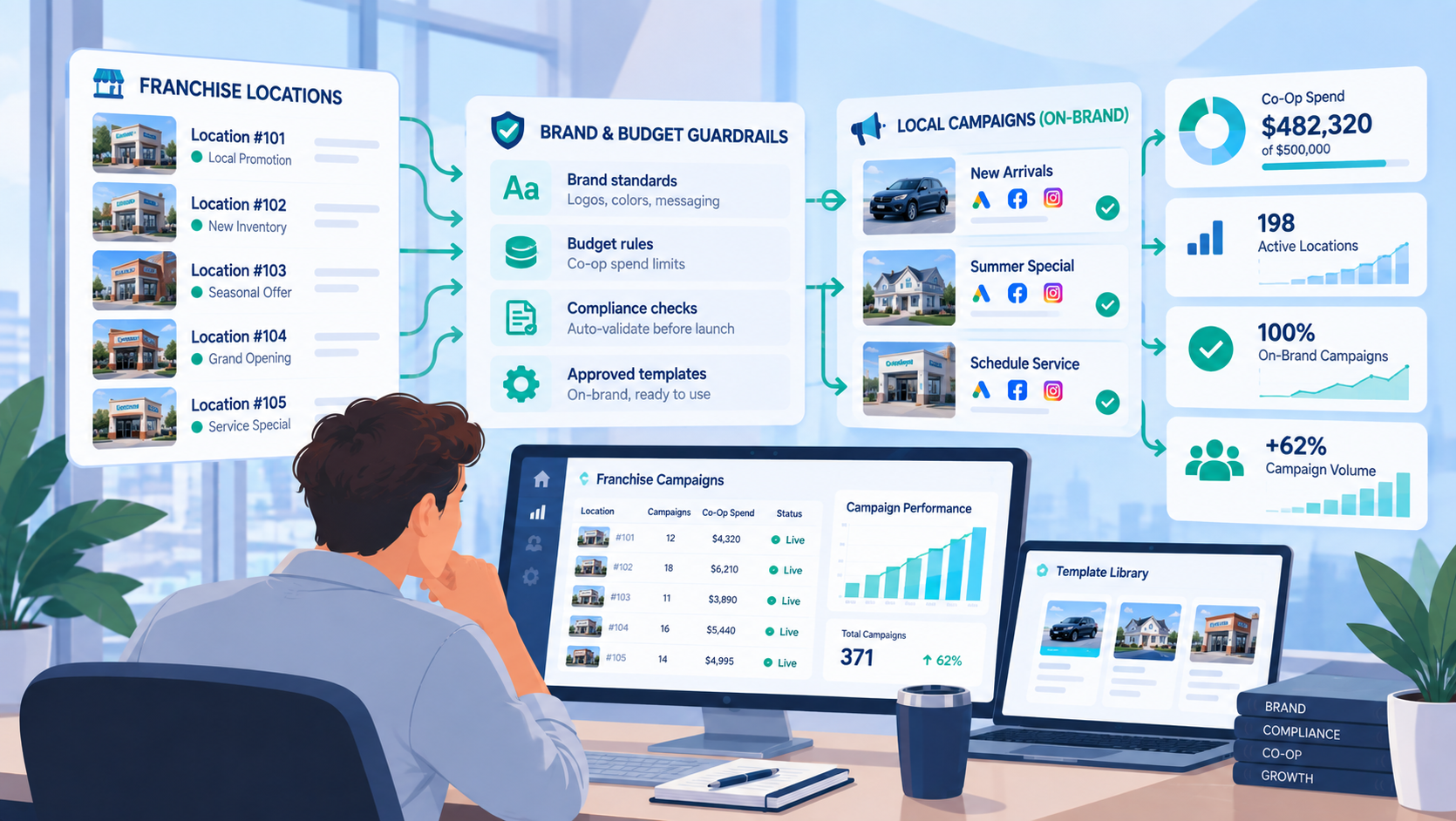
Franchise marketing has a structural problem that's easy to overlook because it's not loud or dramatic. Corporate sets brand guidelines in a document somewhere. Co-op budgets get allocated at the start of a quarter. And then, down at the location level, campaigns get built and launched with very little corporate visibility into what actually went live, whether it followed brand standards closely or loosely, or whether the co-op spend it drew on was tracked accurately against what was approved.
Why this is harder than it sounds
A single-location business has one person, or one small team, deciding what a campaign looks like from start to finish. A franchise system might have two hundred locations, each with a franchisee making their own calls about creative, targeting, and budget, often with limited marketing expertise and essentially no real enforcement mechanism keeping them reliably inside brand guardrails. Corporate can write the standards down. Corporate usually can't check every single campaign across every location against them, not without a team dedicated entirely to that one task.
Co-op spend tracking makes the whole problem worse. When franchisees are drawing on shared advertising funds to run their local campaigns, someone needs to reconcile what was actually spent against what was approved and allocated, and doing that by hand across a large franchise network is close to impossible to do accurately, let alone in anything resembling real time.
What governance without bottlenecks looks like
The answer isn't more approval steps layered on top of the existing process, because approval steps at franchise scale just mean campaigns sit in a queue somewhere while a local promotion loses its relevance waiting for sign-off. The real answer is building brand standards and budget rules directly into the campaign template itself, so a franchisee generating a local campaign is already working inside the right guardrails automatically, not waiting on a corporate reviewer to catch a problem after it's already live.
This is the same pattern that works for large-scale real estate operations, where a major brokerage runs campaigns for over 200,000 agents with corporate-level governance built directly into the generation process. The franchise version of this problem is smaller in raw headcount but identical in shape: distributed people making local decisions, inside a system that enforces brand and budget rules automatically, without anyone having to police it by hand after the fact.
The visibility franchisors actually need
What corporate marketing teams actually want isn't total control over every local creative decision a franchisee makes. It's confidence that what's running across two hundred locations is genuinely on-brand and accurately tracked against co-op spend, without a person having to audit it location by location, campaign by campaign, every quarter. Build the guardrails into the system itself from the start, and that visibility comes standard, instead of requiring an exhausting cleanup project every time someone finally asks for a full picture.
This matters most in the moments franchisors actually get asked to account for their marketing spend, whether that's a board review, a renewal conversation with a major franchisee, or simply an internal audit of where co-op dollars went last quarter. Having the answer ready instantly, broken down accurately by location and campaign, is a very different position to be in than scrambling to reconstruct it after the fact from scattered local invoices and screenshots nobody archived properly, usually under a deadline that doesn't leave room to do it carefully, which is exactly when mistakes in the final numbers tend to happen, and exactly when a franchisor needs those numbers to actually be right, not just close enough to pass a quick glance.
