

The Hidden Cost of Manual Campaign Builds
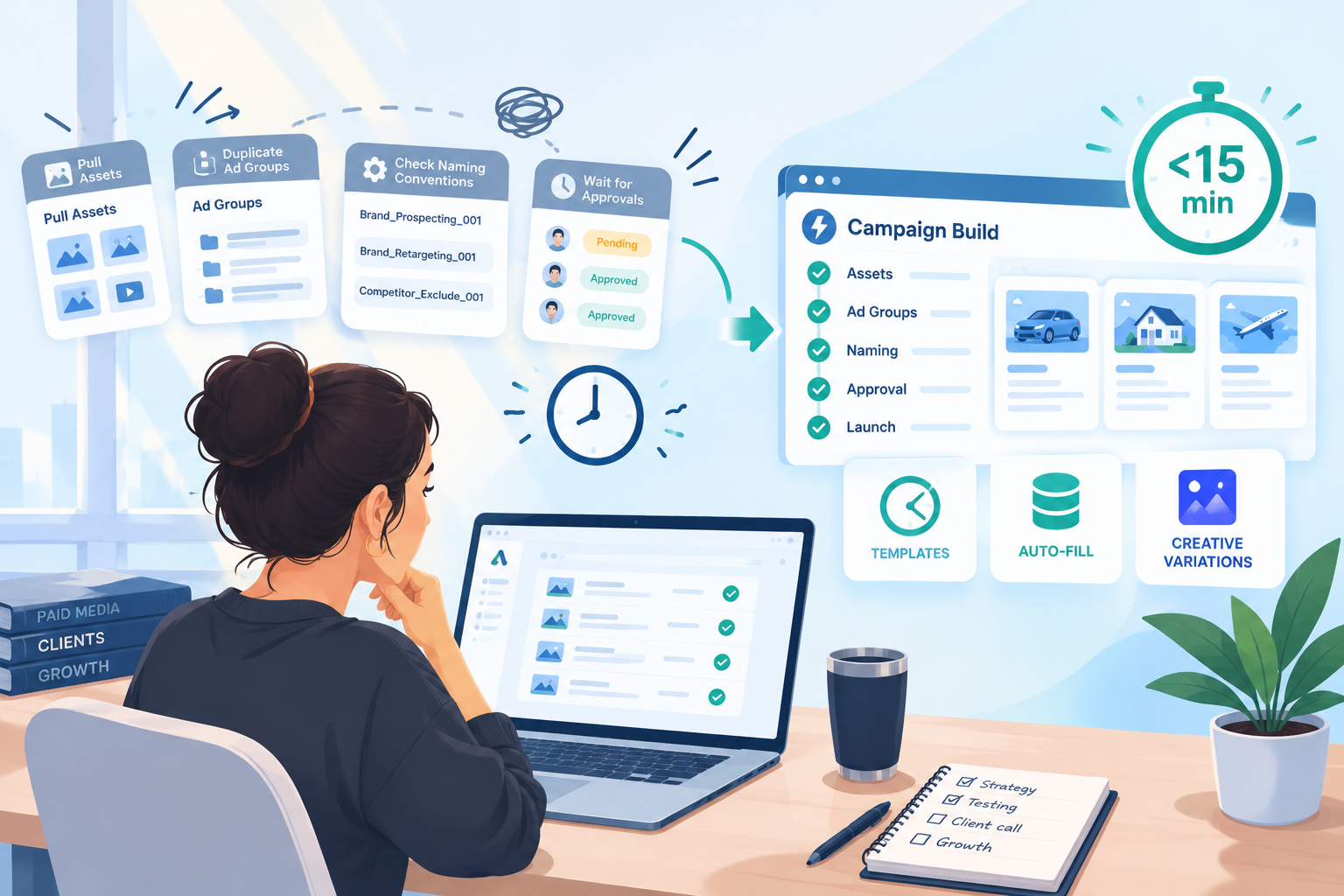
Ask any agency account lead where their week went, and campaign strategy is rarely the honest answer. It's campaign builds: pulling assets, duplicating ad groups, checking naming conventions, waiting on approvals. None of it requires judgment. All of it requires time.
The hours nobody bills for
A campaign build for a single client, done manually, easily eats an hour or more once you count asset prep, QA, and launch. Multiply that across a client roster and the math gets ugly fast. That time doesn't show up on an invoice, but it shows up somewhere: in the strategy work that gets rushed, the growth conversations that get pushed to "next quarter," and eventually in the account team's patience.
The instinct when volume grows is to hire. More clients, more builds, more headcount. But headcount doesn't fix a process problem. It adds more people executing the same manual process, at the same margin.
What actually breaks the pattern
The agencies growing without growing headcount at the same rate have done one thing differently: they've templated the repeatable parts of a build and automated the substitution. A campaign that used to take over an hour to build can take under fifteen minutes when the structure is templated and the inventory or creative variables populate automatically instead of by hand.
That's not a smaller version of the old process, it's a different one. The account team still makes every strategic call: what to test, how to allocate budget, when to push a client toward a new format. They're just not spending Tuesday afternoon copying ad groups to do it.
The ceiling on what automation unlocks
This isn't theoretical. A national automotive marketplace that automated its entire campaign operation reduced its staff requirements by 75% without cutting the number of campaigns it ran. That's the ceiling on what removing manual ops actually unlocks: not marginally faster work, but a structural change in how much output a given team can produce.
The agencies that get this right don't use the saved time to take on more accounts at the same margin. They use it to do the strategy work that was getting rushed: real testing plans, real budget pacing conversations, account reviews that go past the surface-level metrics. That's the work that keeps clients long-term, and it's the work manual builds were quietly crowding out.
The manual ops tax is invisible until you calculate it. Once you do, automating the build layer stops looking like a nice-to-have and starts looking like the only way to grow margin instead of just headcount.
